

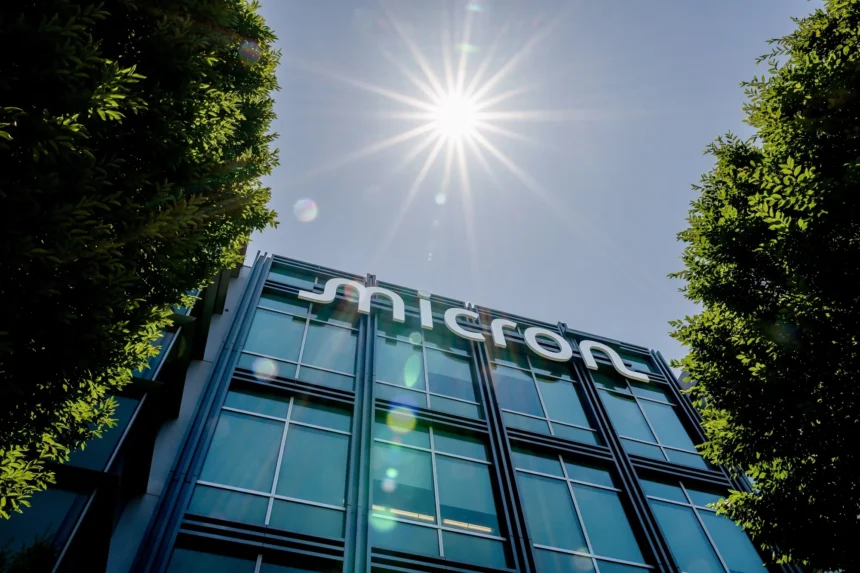

Micron Technology has officially broken ground on a massive new project in Hiroshima Prefecture, Japan. This Micron chip plant expansion in Japan is valued at around 9.3 billion dollars, making it one of the largest semiconductor investments the company has made outside the United States. For anyone following the global chip industry, this move signals just how seriously companies are taking the demand for advanced memory used in artificial intelligence systems.
I have been watching the semiconductor sector closely for a while now, and this particular Micron chip plant expansion in Japan stands out because of its timing and scale. The world is racing to build enough memory capacity to keep up with AI hardware demand, and Japan wants a bigger piece of that supply chain.
What the Micron Chip Plant Expansion in Japan Actually Involves
The Micron chip plant expansion in Japan is centered on the company’s existing Hiroshima facility in western Japan. The investment, listed at 1.5 trillion yen or roughly 9.3 billion dollars, will go toward building out new manufacturing space and installing advanced production equipment. Micron plans to use this expanded facility to produce high-bandwidth memory, often called HBM, which is a critical component in AI processors similar to the ones built by Nvidia.
Installation of semiconductor manufacturing equipment is expected to begin sometime around the first half of 2028, with commercial shipments targeted for around the summer of the same year. This timeline tells me that Micron is planning several years, which makes sense given how long it takes to bring a chip fabrication project from groundbreaking to full production.
Why Japan Is Backing This Investment
One detail that stood out to me while researching this Micron chip plant expansion in Japan is the level of government support behind it. Japan’s Ministry of Economy, Trade and Industry has committed a substantial subsidy toward the project, with figures reported between 3.1 and 3.3 billion dollars depending on the source. This kind of public backing shows that Japan views semiconductor manufacturing as a matter of national economic strategy, not just a private business decision.
Japan has been working for years to rebuild its position in the global chip industry after losing ground to competitors in South Korea and Taiwan. Supporting a Micron chip plant expansion in Japan fits into that broader plan of keeping advanced manufacturing inside allied supply chains rather than depending entirely on a handful of regions for critical components.
Jobs and Local Economic Impact
Beyond the technology angle, this Micron chip plant expansion in Japan is expected to create meaningful employment. Micron has stated that its Japan manufacturing operations could generate around 75000 domestic jobs over the next two decades or more. That is a significant number for the Hiroshima region and reflects how large-scale chip manufacturing tends to support entire local economies, from engineers and technicians to construction workers and suppliers.
From what I have seen in similar projects around the world, chip fabrication investments rarely stay contained to just the factory floor. They tend to pull in logistics companies, equipment vendors, and even housing development around the plant site. The Micron chip plant expansion in Japan is likely to follow that same pattern over the coming years.
The Bigger Picture Behind This Chip Plant Expansion
This Micron chip plant expansion in Japan does not exist in isolation. It is part of a much larger global race among memory chip makers to secure their position in the AI hardware market. High bandwidth memory has become one of the most sought-after components in the tech industry because it directly supports the performance of AI accelerators used in data centers.
Micron is not the only company making these moves. South Korea recently announced its own enormous public-private initiative involving Samsung and SK Hynix, aimed at doubling domestic DRAM production and expanding HBM packaging capacity. When you place the Micron chip plant expansion in Japan next to that kind of regional competition, it becomes clear that no single company can afford to sit still right now.
Micron’s broader global strategy also includes major projects outside Japan. The company is expanding two leading-edge fabrication plants in Boise, Idaho, and held a groundbreaking ceremony earlier this year for a large-scale semiconductor campus outside Syracuse, New York. The Micron chip plant expansion in Japan fits neatly alongside these other investments as part of a coordinated push to grow memory chip supply across multiple countries at once.
What This Means for the AI Industry Going Forward
For everyday readers who are not deeply involved in the semiconductor world, it can be easy to overlook why a factory expansion in Japan matters. But high bandwidth memory shortages have been a real bottleneck for AI hardware makers over the past couple of years. When there is not enough memory to pair with powerful processors, it slows down the entire rollout of new AI systems, from cloud computing platforms to enterprise software tools.
By moving forward with this Micron chip plant expansion in Japan, Micron is positioning itself to compete more directly with SK Hynix and Samsung for long-term supply contracts with major AI chip and cloud customers. Many of these customers are already signing agreements years in advance of when the new production capacity will even become available, which shows just how tight the demand for HBM has become.
As someone who has followed the AI hardware conversation for some time, I think this expansion reflects a pattern we are going to keep seeing. Companies are no longer waiting for demand to arrive before building capacity. They are building ahead of demand because the AI boom has made memory chips one of the most valuable resources in modern computing.
The Micron chip plant expansion in Japan represents more than just another factory upgrade. It reflects a shift in how seriously the tech industry and national governments are treating semiconductor manufacturing as core infrastructure. With strong government backing, a clear timeline, and thousands of jobs on the line, this project in Hiroshima could shape the next phase of AI hardware production for years to come.
As covered by BOL News Technology, developments like this Micron chip plant expansion in Japan are worth watching closely, especially for anyone interested in how the global AI supply chain is being built out in real time.