

Elon Musk has always been a master of blending cutting-edge technology with grand, futuristic narratives, and his latest pitch for xAI is no exception. Following a major restructuring at the AI lab, which included the departure of several key executives, Musk issued an intriguing call to action: “Join xAI if the idea of mass drivers on the Moon appeals to you.” This statement came amid the company’s merger with SpaceX, Musk’s renowned rocket enterprise, setting the stage for what could be a revolutionary era in artificial intelligence development.
The Elon Musk Moon AI vision isn’t just about advancing AGI or disrupting software giants; it’s about pushing humanity’s technological boundaries into outer space, where massive computational power could be harnessed far beyond Earth’s limits. As the combined entity eyes a potential IPO, this strategy serves as a unique recruitment tool, attracting talent fascinated by interstellar innovation rather than mundane AI applications.
The SpaceX-xAI Merger and Recruitment Strategy
The merger between xAI and SpaceX marks a pivotal shift, integrating AI expertise with space exploration capabilities. In the wake of executive exits, Musk’s proclamation highlights a recruitment approach that’s as bold as it is unconventional. While one might expect xAI to focus on deep learning models or clever branding like puns on tech giants, Musk is steering the conversation toward lunar adventures.
This Elon Musk Moon AI narrative emphasizes synergies like constructing AI data centers in orbit, but it goes further by envisioning operations on the Moon itself. By appealing to those excited about mass drivers, electromagnetic launch systems that could propel AI satellites into deep space, Musk is crafting a compelling story to draw in engineers and scientists. This isn’t just about jobs; it’s about joining a mission that could redefine how we build and deploy superintelligent systems, making xAI a magnet for visionary minds in an increasingly competitive AI landscape.
Envisioning AI Data Centers Beyond Earth
Musk’s plans for Elon Musk Moon AI extend well beyond terrestrial data centers, proposing orbital facilities as a starting point for unprecedented computational scale. During an all-hands meeting shared publicly, he posed a provocative question: “What if you want to go beyond a mere terawatt per year?” The answer, according to Musk, lies in relocating to the Moon, where vast energy resources could power enormous AI models. He described a scenario involving a lunar city dedicated to manufacturing space-based computers, which would then be launched via a massive maglev train-like mass driver.
This setup would enable the creation of AI systems capable of processing data at scales unimaginable on Earth, tapping into solar energy directly. The Elon Musk Moon AI concept builds on the idea that deep space offers unlimited potential for expansion, free from planetary constraints like energy shortages or environmental regulations, positioning xAI as a pioneer in extraterrestrial computing.
Shifting Focus from Mars Colonization to Lunar Bases
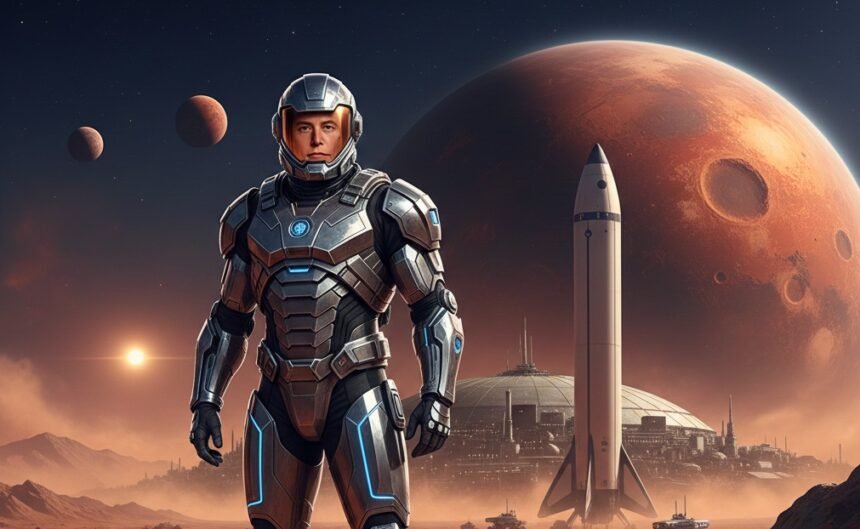
For years, SpaceX’s identity was tied to the dream of colonizing Mars, a vision that inspired countless employees and investors. However, recent developments show a strategic pivot, with the company scaling back Mars ambitions in favor of more immediate goals like satellite deployments for Starlink and NASA lunar missions. The integration of xAI into this fold introduces a new sci-fi metaphor: lunar bases as the foundation for Elon Musk’s Moon AI initiatives.
In a recent Starship update, Musk’s presentations subtly transitioned from Martian robots to Moon-centric ideas, reflecting practical realities. Colonizing Mars proved financially and technically challenging, with early plans for repurposing spacecraft abandoned due to high costs. Now, the Moon offers a more feasible stepping stone, where a self-sustaining city could support AI production.
This shift in the Elon Musk Moon AI storyline maintains the inspirational core of SpaceX’s culture, think “Occupy Mars” t-shirts evolving into lunar-themed motivators while aligning with profitable ventures like government contracts and commercial satellite launches.
Embracing the Kardashev Scale in AI Development
At the heart of Elon Musk’s Moon AI vision is the Kardashev Scale, a framework developed by Soviet astronomer Nikolai Kardashev in the 1960s to classify civilizations based on their energy consumption. Early stages involve harnessing planetary resources, but advanced levels require capturing stellar energy, such as from the Sun.
Musk proposes that a Moon base could achieve this by utilizing a fraction of solar output, potentially a few percent, to fuel massive AI training and operations. “It’s difficult to imagine what an intelligence of that scale would think about,” Musk remarked, underscoring the excitement of such boundless potential.
This theoretical leap ties into broader goals of climbing the Kardashev ladder, where space infrastructure becomes key to technological supremacy. For xAI, this isn’t mere speculation; it’s a roadmap that differentiates the company from rivals stuck in conventional AI development, offering a narrative that’s both philosophically profound and practically ambitious in the realm of Elon Musk Moon AI.
Challenges and Realism in Building Lunar AI Infrastructure
While the Elon Musk Moon AI plans sound exhilarating, they come with significant hurdles that highlight the blend of ambition and pragmatism in Musk’s enterprises. Building AI satellites on the Moon would demand breakthroughs in space manufacturing, such as producing chips in microgravity environments, experiments already underway by scientists and startups.
However, scaling to mass production requires dramatically reducing space travel costs, sourcing raw materials extraterrestrially, and establishing a fully self-sustaining lunar habitat. Critics point out that these prerequisites align with Musk’s other ventures, like reusable rockets and in-situ resource utilization, but timelines stretch into the 2030s or beyond.
Financially, unlike the unprofitable Mars push, orbital data centers could capitalize on surging AI demand, with experts forecasting viability as ground-based costs rise. Yet, the Moon base remains a “stretch goal,” designed to captivate investors and talent. In a field where AI labs often churn out similar products, this Elon Musk Moon AI approach stands out as innovative, even if it borders on the audacious, avoiding the boredom of repetitive tech pursuits.
The Broader Impact on Innovation and Company Culture
Musk’s history of wrapping his companies in epic narratives, from electric vehicles revolutionizing transportation to neural interfaces merging minds with machines, extends seamlessly to Elon Musk Moon AI. This lunar focus reinvigorates xAI’s culture, especially post-merger, by providing a unifying purpose that transcends daily coding tasks.
Departing executives have noted the monotony in the AI sector, where everyone builds similar large language models. Still, Musk’s vision injects excitement: imagine engineers collaborating on solar system-scale supercomputers launched from the Moon. For retail investors eyeing the IPO, this story could mirror Tesla’s meteoric rise, turning speculative dreams into market value.
Moreover, it signals a maturation in SpaceX’s strategy, prioritizing revenue-generating projects while keeping the flame of multi-planetary aspirations alive. As AI evolves, the Elon Musk Moon AI paradigm could inspire a new generation of innovators, proving that bold, unconventional ideas are essential for breaking through technological plateaus.
The Future of Elon Musk’s Moon AI
In summary, Elon Musk’s proclamation about mass drivers on the Moon isn’t just quirky recruitment banter; it’s a cornerstone of the Elon Musk Moon AI strategy that fuses xAI’s AI prowess with SpaceX’s spacefaring expertise. By shifting from Mars fantasies to lunar realities, Musk crafts a narrative that’s both motivational and strategically sound, addressing energy needs for next-gen AI while captivating global audiences.
Whether this leads to actual Moon bases or serves as a catalyst for innovation, the vision underscores Musk’s knack for turning science fiction into tangible progress. As xAI and SpaceX forge ahead, the Elon Musk Moon AI era promises to be anything but ordinary, inviting us all to ponder the limitless possibilities of intelligence scaled across the cosmos.