

President Donald Trump has taken his long-running legal battle with writer E. Jean Carroll to the highest court in the land. On Tuesday, his attorneys filed a petition asking the Supreme Court to throw out the $83.3 million defamation verdict a jury awarded Carroll in January 2024. It is the latest chapter in a case that has already stretched across two presidential terms and multiple courtrooms.
If you have followed this story since it began, you know it is not a simple one. There are two separate verdicts, two juries, and now two separate trips to the Supreme Court. Let me walk you through what just happened, why it matters, and what could come next.
What Trump’s Legal Team Is Actually Arguing
Trump’s lawyers are leaning almost entirely on one argument: presidential immunity. They claim that because Trump made his 2019 statements about E. Jean Carroll while sitting in the Oval Office and responding to reporters’ questions, those comments count as official acts of the presidency.
That distinction matters a lot. In 2024, the Supreme Court ruled that presidents enjoy broad immunity for official acts taken while in office. Trump’s team is now arguing that this earlier ruling should have wiped out the Carroll verdict entirely.
In the filing, Trump’s attorneys wrote that this is the first case in the nation’s history where a court imposed damages liability on a president for conduct carried out while in office. They argue the Second Circuit Court of Appeals never properly settled whether presidential immunity applied here at all.
A Quick Recap of the E. Jean Carroll Case
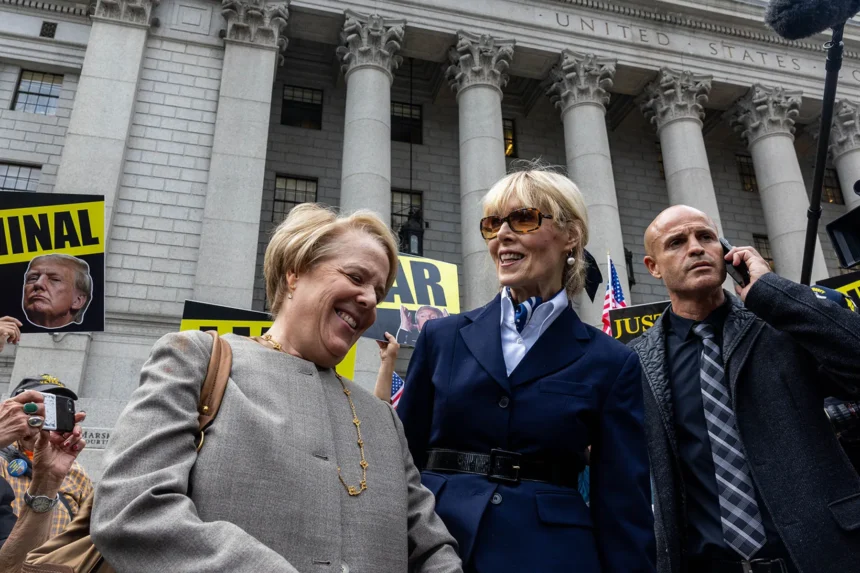
For anyone just catching up, E. Jean Carroll is a former magazine columnist who accused Trump of sexually assaulting her in a dressing room at a Bergdorf Goodman department store in the mid-1990s. Trump denied the allegation publicly and repeatedly, calling her claims fabricated.
Those denials led to two separate lawsuits. In May 2023, a jury found Trump liable for sexually abusing Carroll and for defaming her with 2022 statements, awarding her $5 million. Then in January 2024, a second jury looked specifically at Trump’s 2019 statements, made while he was president, and awarded E. Jean Carroll $83.3 million in damages.
That second verdict is the one now heading to the Supreme Court. A federal appeals panel had already upheld it, calling the damages reasonable given what it described as extraordinary and egregious facts.
Why the Second Circuit Rejected Trump’s Immunity Claim
This is where things get interesting from a legal standpoint. The appeals court did not simply ignore the immunity argument. Judges found that Trump had actually waived his right to raise presidential immunity earlier in the litigation process, before the 2024 Supreme Court ruling even existed.
The panel also concluded that the 2024 immunity decision did not change their view of the case. In their reasoning, defending against personal misconduct allegations tied to fitness for office does not automatically transform every public statement into an official presidential act.
Trump’s new Supreme Court petition pushes back hard on that reasoning. His lawyers argue the appeals court sidestepped the immunity question on procedural grounds rather than actually deciding whether the doctrine applied.
This Isn’t the First Trip to the Supreme Court
Something worth noting here. This is actually the second time in recent months that Carroll-related litigation has landed at the Supreme Court’s door. Just weeks earlier, the justices declined to take up a separate appeal from Trump involving the original $5 million verdict tied to the sexual abuse and 2022 defamation claims.
Trump said publicly at the time that he would continue fighting. This new $83.3 million petition appears to be part of that continued effort, just aimed at a different verdict from a different trial.
It is worth being upfront that Trump’s team faces an uphill climb. The Supreme Court agrees to hear only a small fraction of the petitions it receives each year, and the fact that the justices already passed on the related $5 million case does not exactly signal enthusiasm for revisiting Carroll-related matters.
What Happens Financially While the Appeal Plays Out
One detail that often gets lost in the legal back and forth is what has actually been paid so far. Court records from earlier this month showed that E. Jean Carroll has collected roughly $5.63 million from Trump toward the judgments against him.
Across both verdicts combined, Carroll has now won a total of $88.3 million in civil rulings against Trump. That is a significant sum by any measure, and it reflects seven years of litigation stretching back to when Trump first denied the assault allegation publicly.
Filing a Supreme Court petition does not automatically pause payment obligations, so this is a case where the legal fight and the financial reality are running on somewhat separate tracks.
Why This Case Matters Beyond Trump and Carroll
I think it is easy to view this purely as a Trump story, but there is a broader legal question buried in here that could affect how presidential immunity gets applied going forward. If the Supreme Court eventually takes this case, it would need to clarify just how far that 2024 immunity ruling extends.
Does responding to a reporter’s question about a personal allegation count as an official act simply because the president happened to be standing at a podium in the White House? Or does the personal nature of the underlying accusation pull it outside of official conduct entirely? That distinction could shape how future presidents, of any party, respond to personal allegations while in office.
This is exactly the kind of nuanced legal question that legal scholars, journalists, and outlets covering topics from BOLNews to political law will likely be dissecting for months if the court decides to take it up.
What to Watch For Next
The petition has been filed, but as of this writing it has not yet been formally docketed at the Supreme Court. That is an important procedural step, and until it happens there is no clear timeline for when or if the justices will decide whether to hear the case.
Typically, the Supreme Court takes several weeks to months to decide whether to grant certiorari, meaning agree to hear a case. Given the court declined to review the related $5 million verdict just weeks earlier, there is genuine uncertainty about which way this will go.
E. Jean Carroll herself has not shied away from the public spotlight throughout this process, often speaking candidly about the verdicts and what they represent to her personally. Whether the Supreme Court agrees to weigh in again on her case remains an open question, and one worth watching closely in the coming months.
A Balanced Look at Where Things Stand
Trump’s petition represents a serious legal strategy built around a real and previously established immunity doctrine, not a frivolous long shot. At the same time, two lower courts have already rejected similar arguments, and the Supreme Court’s recent decision not to hear the related case suggests the justices may not be eager to revisit Carroll litigation so soon.
Whatever the outcome, the case remains a significant marker in how American courts are working through what presidential immunity actually covers when personal allegations and official conduct start to overlap. For now, the ball sits with the Supreme Court, and both sides are left waiting to see if the justices decide this is a fight worth taking on.